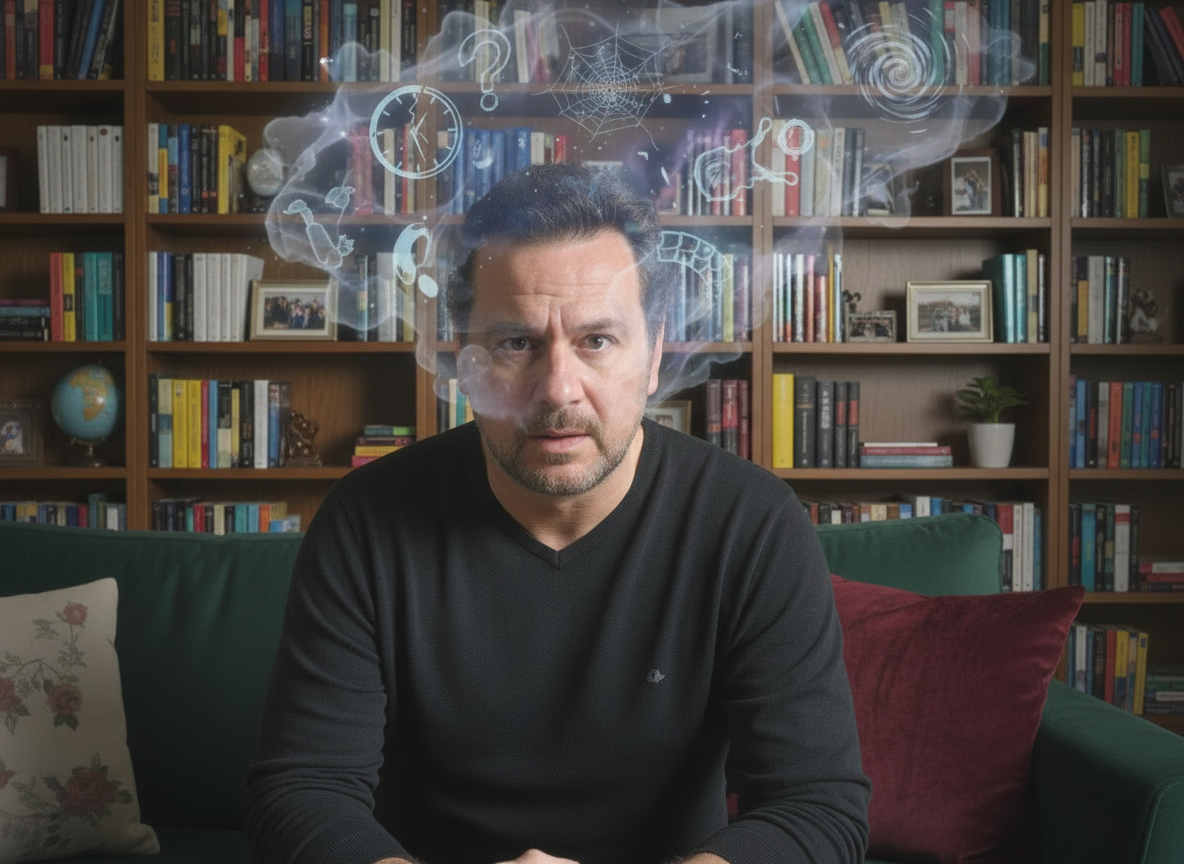
Rob Kaufman writes psychological thrillers from a place of controlled unease. His work suggests a mind acutely attuned to what people suppress rather than what they reveal. He is less interested in spectacle or overt violence than in the quiet moments where a character hesitates, lies, or rationalizes a choice they already know is wrong. For Kaufman, tension is not created by action alone but by proximity to truth—how close a character comes to it, and how deliberately they turn away.
At the core of his psychological landscape is an obsession with identity fracture. His protagonists are often successful, articulate, and outwardly stable, yet internally divided. They construct narratives to survive—about their pasts, their relationships, their morality—and the thrill of Kaufman’s work lies in watching those narratives slowly corrode. He understands self-deception not as weakness but as a sophisticated survival skill, one that eventually becomes dangerous when it outlives its usefulness.
Kaufman demonstrates a strong preoccupation with moral ambiguity. He does not frame characters as purely good or evil; instead, he places them under emotional pressure and observes what they justify. His antagonists are rarely monsters in the traditional sense. They are mirrors, catalysts, or accelerants—figures who force buried truths into the open. This reflects an authorial psychology that mistrusts easy blame and is deeply interested in complicity, silence, and the cost of looking away.
Emotionally, his writing suggests high cognitive empathy paired with restraint. He understands fear, shame, desire, and grief in granular detail, yet he resists melodrama. Feelings are conveyed through physical behavior—breath held too long, hands tightening, conversations cut short—rather than overt exposition. This implies an author who values observation over confession, and who believes readers are most unsettled when they are required to infer rather than be told.
A recurring psychological motif in Kaufman’s work is the belief that truth emerges under constraint: illness, impending death, isolation, or extreme stress. This points to a worldview in which comfort breeds dishonesty, and crisis strips it away. His characters often discover that they are most honest when they believe time is running out—an idea that recurs both thematically and structurally in his plots.
As an author, Kaufman appears highly controlled, meticulous, and deliberate. His narratives are carefully paced, his revelations strategically delayed. This suggests a personality that values mastery over impulse and sees storytelling as a form of psychological engineering. He builds tension the way a clinician builds a case: patiently, methodically, allowing patterns to emerge until denial is no longer plausible.
Ultimately, Rob Kaufman’s psychological profile is that of an observer of human fracture points. He writes not to reassure but to unsettle, not to punish characters but to expose them. His thrillers operate on the belief that the most dangerous lies are the ones we tell ourselves—and that the moment those lies fail is where the real story begins.